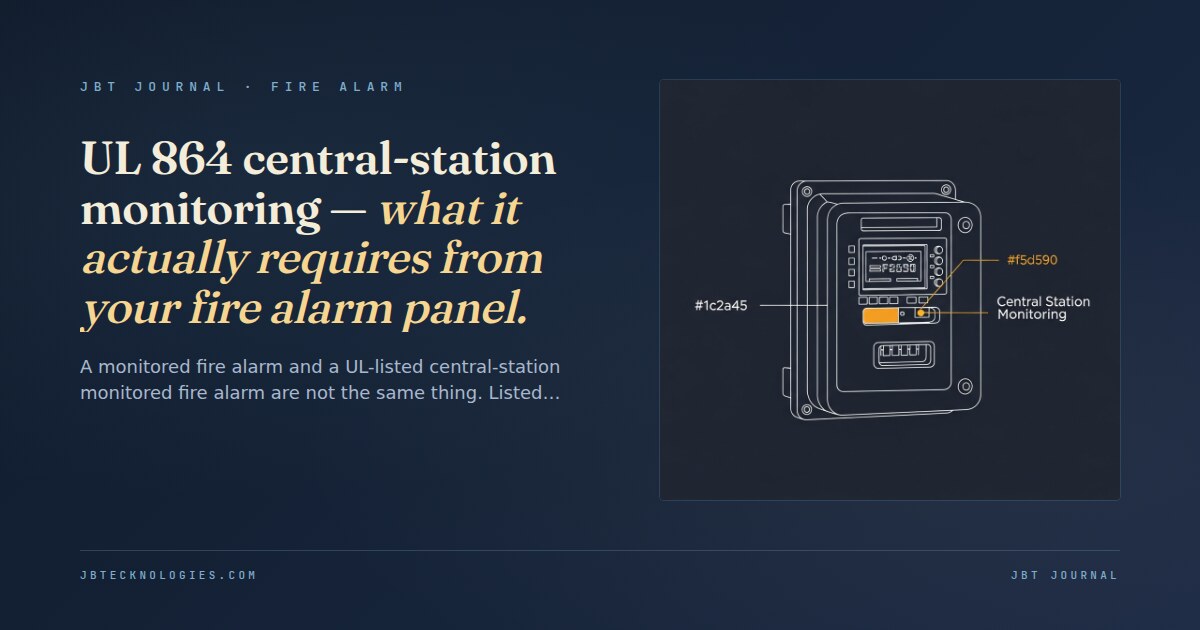
Fire alarm central-station monitoring is a requirement most building owners know they need and few understand in detail. The phrase “monitored fire alarm” on a certificate of occupancy or an insurance policy covers a significant range of configurations — from a UL-listed central station providing around-the-clock signal receipt and emergency dispatch to a basic telephone dialer that calls a local security company during business hours. NFPA 72 classifies these differently, and the difference matters for code compliance, insurance, and the AHJ approval that gates your CO.
Understanding what the communication path between the panel and the monitoring station actually requires — and where panel compatibility problems surface at monitoring cutover — is how you avoid the CO hold that comes from incomplete monitoring documentation.
NFPA 72 monitoring categories — what “central station” actually specifies
NFPA 72 Chapter 26 defines four supervising station categories: Central Station (Section 26.3), Remote Station (Section 26.4), Proprietary Supervising Station (Section 26.5), and Auxiliary Alarm System (Section 26.6). Most commercial buildings require a Central Station or Remote Station, but the terms are used interchangeably in specifications where they shouldn’t be.
A Central Station service, as defined by NFPA 72 Section 26.3, requires a UL-listed central station facility — one that meets UL 827 requirements for the facility itself, not just the equipment. It requires documented response procedures, specific staffing, redundant communication paths, and periodic performance audits. Not every monitoring company operates a UL-listed central station. “24/7 monitoring” and “UL-listed central station monitoring” are not the same thing. Buildings that need an Emergency Communications System under NFPA 72 Chapter 24 also require Central Station monitoring for ECS signals — the mass notification and Chapter 24 post covers when ECS is required and how its monitoring requirements differ from standard fire alarm signal receipt.
UL 827 and the central station listing
UL 827 is the standard for central station alarm services. It defines requirements for the facility, equipment, operating procedures, and service delivery. A UL-listed central station has been independently evaluated against these requirements and is subject to ongoing periodic audits. The UL listing of the central station is what most insurance carriers and AHJs mean when they specify “UL-listed central station monitoring” as a requirement.
The UL listing of the fire alarm control panel (UL 864) and the UL listing of the central station (UL 827) are separate certifications. A UL 864-listed panel connected to a non-UL-listed monitoring company does not satisfy a UL 827 requirement. Both elements — the panel and the monitoring service — must meet their respective standards for the combination to comply with specifications that require UL-listed central station monitoring. This distinction is rarely explained in the monitoring company’s sales process.
Panel compatibility at monitoring cutover — where surprises actually surface
Monitoring cutover — the transition from test condition to live supervised monitoring — is where compatibility problems appear. Common cutover issues:
- Communicator listing mismatch: The central station’s required communication path device is not listed with the specific panel model. Manufacturer compatibility matrices define which communicators are tested and listed with which panels; an unlisted combination can create a violation that the AHJ catches during the monitoring verification documentation review.
- Supervision interval conflicts: NFPA 72 Table 26.6.3.2.1 defines maximum allowable supervision test intervals for different communication path types. An IP path with a 200-second supervision interval may fail the AHJ’s verification if the jurisdiction has adopted a stricter interval requirement.
- Account provisioning delays: The central station account must be active and the panel programmed with the correct account number, receiver address, and encryption keys before monitoring can go live. Last-minute provisioning when the CO inspection is already scheduled creates delays that could have been avoided with earlier coordination — typically 2–3 weeks before the inspection date.
| Communication path type | Supervision method | NFPA 72 max test interval | Notes |
|---|---|---|---|
| DACT (dual analog phone) | Periodic test signal over both lines | 24 hours | POTS availability declining; not recommended for new installations |
| IP communicator | Heartbeat/poll over IP | 200 seconds (some jurisdictions stricter) | Requires reliable broadband; single-path IP may not satisfy dual-path requirement |
| Cellular communicator | Heartbeat over carrier network | Varies by device listing | Used as primary or backup path; multi-network SIM preferred |
| IP + cellular (dual path) | Heartbeat over both paths, failover on path loss | Per device listing | Preferred for new NFPA 72-compliant installations; satisfies dual-path supervision |
What the annual inspection documentation must include
The annual inspection documentation for a centrally monitored fire alarm system must include a record of the monitoring test conducted during the inspection and a confirmation that signal receipt was verified at the central station. NFPA 72 Table 14.3.1 defines inspection and testing intervals for supervising station communication paths — the same table that governs device-level inspection frequencies. Georgia’s fire alarm inspection frequency requirements layer state and local AHJ amendments on top of the NFPA 72 base schedule; the monitoring communication path is among the items that must be verified on the Georgia-specific calendar.
A central station monitoring arrangement that worked at original commissioning can fall out of compliance if the communication path is changed without verifying the new path meets current NFPA 72 supervision requirements, the central station’s UL 827 listing lapses or the company is acquired, or panel firmware updates alter communication behavior in a way the central station’s receiver no longer handles correctly. Annual inspection is the mechanism that catches these drifts before they become AHJ violations.
What to confirm before selecting a monitoring service
A fire alarm specification that requires “UL-listed central station monitoring” without further detail leaves several decisions to the installer that the building owner should be making:
- Confirm the monitoring company’s UL 827 listing. Request the current UL listing certificate for the specific facility, not just a statement that the company is “UL-listed.”
- Confirm communication path compatibility with the specified panel. The AHJ reviewing the fire alarm submittal may require evidence that the communicator is listed with the panel.
- Confirm the supervision interval meets both NFPA 72 requirements and any stricter local AHJ requirements. Your fire alarm contractor should know the local standard.
- Confirm account provisioning lead time with the monitoring company. Accounts for new construction should be provisioned 2–3 weeks before the CO inspection to avoid last-minute delays.
These items are not difficult to verify, but they are routinely left until commissioning and occasionally discovered to be wrong at that point. The addressable vs conventional system comparison covers the panel technology decisions that determine which communication path options are available — the monitoring compatibility question flows directly from the panel choice made at design time. Our fire alarm services in Atlanta and the Southeast include monitoring coordination as part of the commissioning scope, so the central station account, communication path listing, and AHJ documentation are confirmed before the CO inspection is scheduled.
Installing or upgrading a fire alarm system in Atlanta or the Southeast?
We design and install NFPA 72-compliant fire alarm systems with UL-listed central station monitoring coordination for commercial buildings in Atlanta and the Southeast — including the communication path listing verification and account provisioning that keeps the CO inspection on schedule.