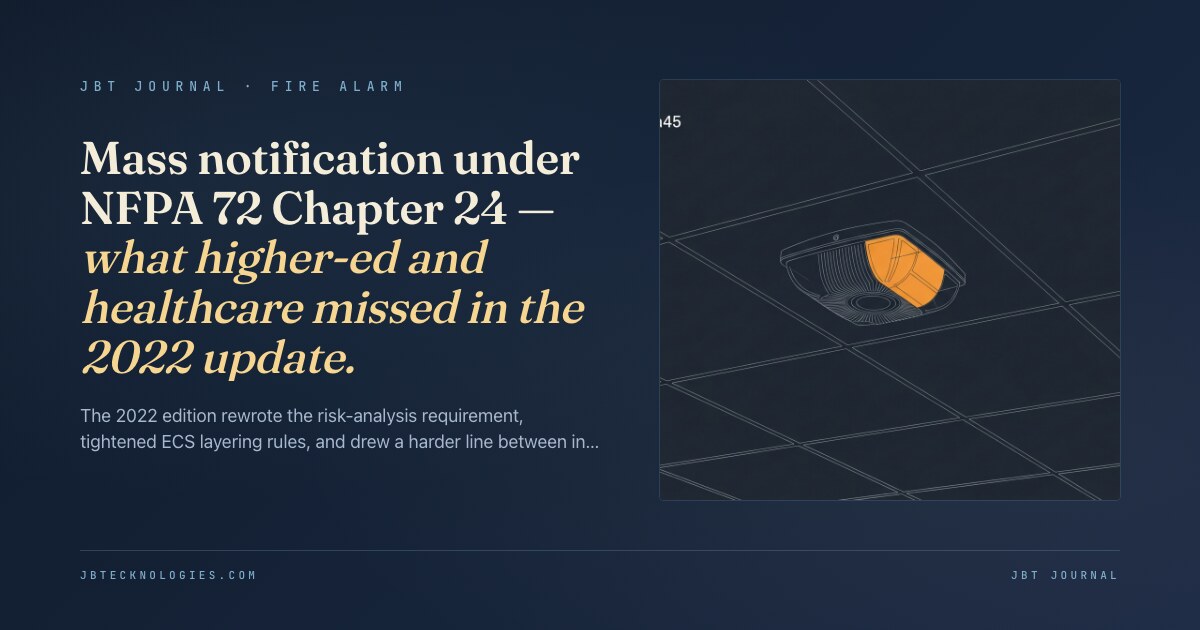
Most mass notification projects begin the same way: an emergency manager at a university or a hospital security director sits through a near-miss — an active threat, a severe weather event, a chemical release — and discovers that the building’s PA system wasn’t designed to communicate anything intelligibly under emergency conditions. The loudspeakers are too quiet. The zones are wrong. The fire alarm overrides the voice system. The staff can’t override the automated announcement to give live instructions.
Then someone points at NFPA 72 Chapter 24 and says the system has to meet it. And that’s where it gets complicated, because NFPA 72 Chapter 24 has changed significantly from the 2019 to the 2022 edition — and the systems installed, designed, or grandfathered before the 2022 cycle are increasingly likely to fail the risk-analysis step the new edition requires.
What NFPA 72 Chapter 24 actually governs
Chapter 24 covers Emergency Communications Systems (ECS) — the broader category that includes mass notification, one-way and two-way in-building systems, public address, and the interfaces between those systems and fire alarm. The chapter distinguishes between:
- In-Building Fire Emergency Voice/Alarm Communications Systems (EVACS): The voice component of the fire alarm system. Governed in parallel by Chapter 24 and the fire alarm requirements in Chapters 10 and 12.
- In-Building Mass Notification Systems (MNS): Systems used to communicate non-fire emergencies (active threat, severe weather, hazmat, shelter-in-place) within a structure.
- Wide-Area Mass Notification Systems (WAMNS): Outdoor systems — giant voice (outdoor loudspeaker arrays), wireless emergency alerts, digital signage networks.
- Combination Systems: Architectures that handle both fire and non-fire notifications, often using the same speaker plant but separate control and signal paths.
The 2022 edition tightened how these categories interact and where one system is allowed to override or subordinate another. That’s the change that is catching retrofits.
The risk-analysis requirement — what changed in 2022
The 2019 edition of NFPA 72 required a risk analysis for MNS design but was vague about who performed it, what it had to document, and whether the AHJ had standing to require it before approving a system. The 2022 edition is specific:
- A documented risk analysis is required as a design input for any in-building MNS. The analysis must identify the hazard scenarios the system is designed to address.
- The analysis must document the assumed population (resident, transient, mobility-impaired, non-English-speaking) for each area of the building.
- The system design must demonstrate how it addresses each identified hazard scenario — signal type, intelligibility, redundancy, and operator control capabilities.
- The AHJ may require the risk analysis as part of plan review. Jurisdictions with active AHJs in healthcare and higher education are increasingly doing exactly that.
The practical effect: a legacy MNS that was installed to meet a prior edition’s speaker coverage requirements may not have a documented risk analysis. When the system comes up for renovation, expansion, or AHJ inspection, the first question is now “where’s the risk analysis?” — and the answer is often “we don’t have one.”
ECS layering with the fire alarm — the priority hierarchy
The most technically complex change in the 2022 edition is the clarified priority hierarchy for combination systems where the fire alarm and the MNS share loudspeakers. The general rule in the prior edition was that fire alarm signals had priority. The 2022 edition adds nuance:
- Fire alarm evacuation signals retain priority over MNS signals in most configurations. A fire alarm that is actually in alarm state will override an MNS announcement.
- MNS signals may be granted priority over fire alarm supervisory or trouble signals if the authority having jurisdiction approves it and the system documentation specifically addresses the priority logic.
- Operator-initiated MNS messages may take priority over pre-recorded fire alarm voice messages if the system is configured and documented to support it — but this requires explicit AHJ approval and specific control-point documentation.
- All-hazard MNS controllers — systems that handle both fire and non-fire emergencies from a single head end — must document the priority logic explicitly in the system design documents and provide the AHJ a written description of how priority conflicts are resolved.
The gotcha: many combination systems installed in 2018–2021 have priority logic that was set during commissioning and never formally documented in a way that satisfies the 2022 edition’s documentation requirements. The system works correctly in operation, but the paperwork doesn’t exist. When the AHJ asks for priority documentation at the next inspection, the answer has to come from the integrator’s commissioning records — if those exist.
In-building MNS vs. giant voice — where the line is drawn
Higher education campuses often have both in-building systems and outdoor wide-area notification (giant voice loudspeaker arrays on poles and building exteriors). The 2022 edition draws a cleaner line between what each system is responsible for:
| System type | Primary population | Signal intelligibility standard | Typical medium |
|---|---|---|---|
| In-building MNS | Occupants inside the building | STI-PA ≥ 0.45 per NFPA 72 18.4 | In-ceiling and surface-mount loudspeakers |
| Wide-area MNS (giant voice) | People on outdoor campus areas | Not STI-PA specified; SIL-based design | Pole-mounted array speakers, 100–500W drivers |
| Combination/hybrid | Both indoor and outdoor | Indoor zones must meet STI-PA; outdoor zones SIL-based | Both; separate zone control required |
The architectural implication: a giant voice loudspeaker aimed at a building’s exterior does not satisfy in-building MNS requirements for that building’s interior. Some campus emergency managers assumed that outdoor arrays would penetrate into nearby buildings. In most modern construction — curtain-wall glass, insulated metal panels, concrete — they do not achieve the STI-PA threshold required by NFPA 72 18.4 at interior locations. The buildings need separate in-building coverage.
What the AHJ is actually checking at inspection
The inspection checklist for a 2022-edition MNS in a healthcare or higher-education jurisdiction with an engaged fire marshal now typically includes:
- Risk analysis document. The written hazard-scenario analysis, including identified populations and how the system design addresses each scenario.
- Priority documentation. Written statement of how the system resolves priority conflicts between fire alarm and MNS signals, signed by the designer of record.
- STI-PA measurements. Measured Speech Transmission Index results at representative sample locations in each coverage zone. Not just coverage maps from a model — measured results from a commissioned system.
- Operator control documentation. Identification of all control points (IP-based workstations, wall panels, portable controllers), who has access, and what authority each control point has.
- Battery backup verification. In-building MNS components must have minimum 24-hour standby plus full-load operation duration per the design, consistent with the fire alarm infrastructure they share.
- Interface test with fire alarm. A functional test showing that fire alarm activation correctly overrides or integrates with the MNS signals per the documented priority logic.
Speech Transmission Index for Public Address (STI-PA) is a 0–1 scale measuring how intelligible amplified speech is in a space. A score of 0.45 is the minimum NFPA 72 requires for occupied areas — roughly the threshold where most listeners can understand a live announcement under normal background noise. Reverberant spaces (large atria, hard-surface corridors, gymnasiums, dining halls) routinely test below 0.45 without deliberate acoustic treatment or directional speaker design. The measurement has to be done with the space occupied at the design population level, or with a correction factor for background noise. A measurement taken in an empty building on a Saturday morning and used to certify a full-occupancy system is not a valid measurement.
The retrofit path — where to start if your system predates 2022
The practical sequence for a higher-ed or healthcare facility whose in-building MNS was designed before the 2022 edition:
- Pull the as-built documentation. You need the original design documents, the commissioning test report, and any prior AHJ acceptance letters. If those don’t exist, start with a field assessment of what’s actually installed.
- Perform a gap analysis against NFPA 72-2022 Chapter 24. Compare the existing design and documentation against the current edition’s requirements. Identify the gaps: missing risk analysis, undocumented priority logic, STI-PA not measured, control points not documented.
- Produce or update the risk analysis. This is usually a day or two of structured facilitation with the emergency manager, facilities team, and legal or risk management. The output is a written document that describes the hazard scenarios and how the system addresses each one.
- Measure STI-PA in the highest-risk zones. If the existing speaker system is the same as what was installed, and the spaces haven’t changed significantly, the system may already meet the threshold — you just don’t have the measurements. Measure before you replace hardware.
- Document and update priority logic. Get the commissioning integrator to produce written priority-logic documentation. If the original integrator isn’t available, a qualified fire alarm contractor can extract the configuration from the head-end controller and translate it into prose documentation.
- Submit the documentation package to the AHJ for review. In most jurisdictions, an updated documentation submission without hardware changes doesn’t require a full plan review fee. Check locally — some jurisdictions treat any documentation update as a modification requiring a permit.
Bottom line
The 2022 edition of NFPA 72 Chapter 24 didn’t invent new physics or require new hardware in most cases. What it did was formalize the documentation and analysis requirements that serious installations had always done informally, and made those requirements enforceable at the AHJ level. For facilities that were designed with a genuine risk analysis and proper commissioning, compliance is mostly a documentation exercise. For facilities that were designed to a speaker-coverage specification without a risk analysis behind it, the update is an opportunity to discover whether the system that was installed will actually work the way it needs to in an emergency — before an emergency finds out first.
Need a gap analysis on your in-building MNS?
We assess existing systems against NFPA 72-2022 Chapter 24, produce the risk-analysis documentation, measure STI-PA in occupied zones, and prepare the AHJ submission package. Serving Atlanta and the Southeast.