The standard answer to “addressable or conventional?” in commercial fire alarm design is “addressable” — and for most projects above a certain complexity threshold, that answer is correct. But the “always addressable” default can add meaningful cost to small, simple buildings where the diagnostic advantages of addressable technology don’t translate to real operational benefit.
Understanding where the break-even actually falls — in terms of point count, building complexity, and owner operational capability — is how you write a specification that doesn’t over-engineer a small warehouse and doesn’t under-engineer a hospital. The Georgia AHJ compliance context for fire alarm systems, including NFPA 72 inspection schedules and what changes when a system is conventional vs. addressable, is covered in the Georgia fire alarm inspection frequency post.
What the difference actually is — technically
A conventional fire alarm system connects initiating devices (smoke detectors, pull stations, heat detectors) in parallel on zone circuits. When a device activates, current change on that zone circuit triggers an alarm — but the panel only knows which zone activated, not which device. A typical zone circuit carries 10–30 devices; a building with 4 zones has at most 4 alarm-location resolutions regardless of how many devices are on each zone.
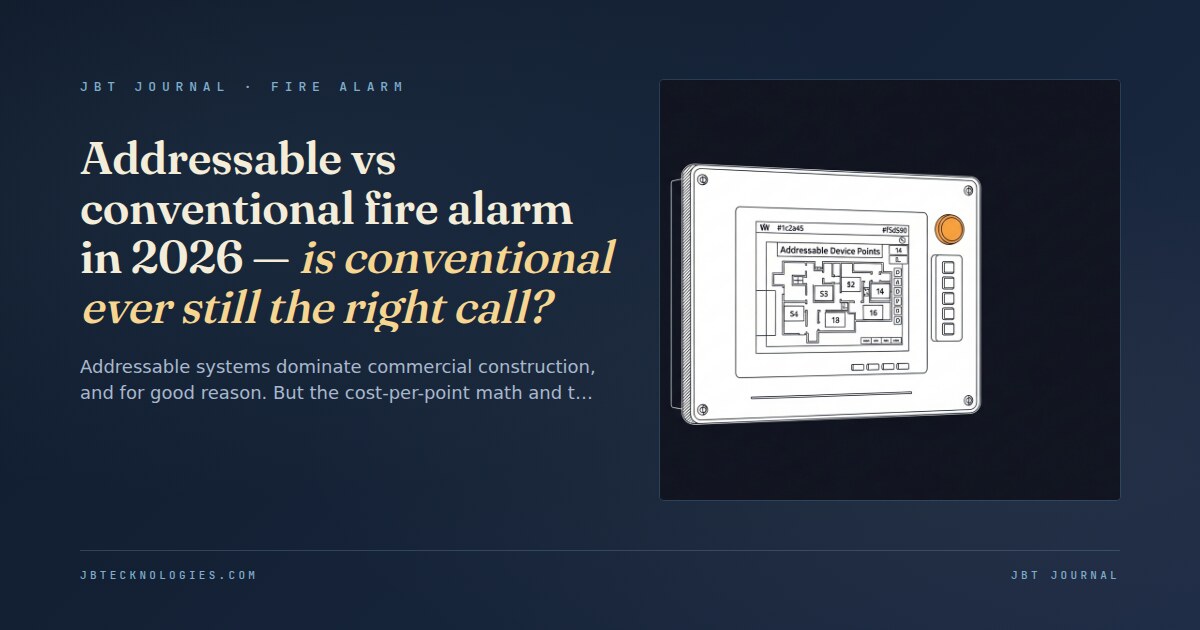
An addressable system assigns a unique address to every initiating device and notification appliance circuit on the SLC (Signaling Line Circuit). When a detector activates, the panel reports exactly which device — room 212 ceiling smoke detector, initiating device address 2.1.047. Troubleshooting, alarm response, and maintenance are all informed by precise device-level data.
Cost per point — where addressable actually costs more
The cost premium for addressable systems shows up primarily in the initiating devices, the panel, and the installation labor per device. Addressable smoke detectors typically cost 40–80% more than conventional counterparts. Addressable pull stations are similarly priced higher. An addressable FACP with SLC capability costs more than a conventional panel of equivalent zone count. The labor cost per device is comparable, but the material cost differential is real and scales with device count.
For a 30-point building with 2 zones, the addressable premium may add $3,000–$8,000 to the installed cost. For a 500-point building, the addressable premium is absorbed by operational savings — reduced troubleshooting labor, faster alarm response routing, and simpler inspection documentation. The breakeven point varies by project, but as a rough benchmark: buildings under 30–40 initiating devices in a simple, single-use occupancy are the candidates where conventional deserves a cost comparison rather than a default rejection.
Troubleshooting time — the hidden cost of conventional
The most significant operational disadvantage of conventional systems is troubleshooting time. A ground fault or open circuit on a 20-device zone circuit requires inspecting each device and each cable junction to find the fault location. In a finished commercial space with devices on ceilings, above drop tiles, and in equipment rooms, this is a multi-hour task per event. A building that generates 6–8 trouble events per year on a conventional system pays more in maintenance labor than the initial cost premium of addressable would have been, typically within the first 3–5 years of operation.
Addressable systems reduce troubleshooting labor to the specific fault location. The panel identifies the device or the cable segment (on systems with addressable circuit monitoring). A technician can walk directly to the problem. For buildings with a facilities manager or maintenance staff who respond to trouble events, the addressable advantage in troubleshooting translates directly to billable labor hours saved. The system documentation practices that make either technology easier to maintain are the same ones covered in the low-voltage contractor selection post: clean test reports and device-level documentation are what make both initial commissioning and ongoing maintenance efficient.
When conventional is still a defensible choice in 2026
Conventional fire alarm systems remain code-compliant under NFPA 72 for appropriate building types. The cases where conventional is genuinely the better specification in 2026:
| Building profile | Conventional appropriate? | Reason |
|---|---|---|
| Single-tenant warehouse, 1–2 zones, < 30 devices | Yes, with conditions | Low device count; zone-level resolution adequate for space size; minimal troubleshooting events |
| Small retail strip tenant, 1 zone, < 15 devices | Yes | Zone resolution sufficient for single-tenant space; low annual trouble-call volume |
| Replacement or expansion of existing conventional system | Sometimes | Matching existing panel technology may be cost-effective if panel is current generation and device count is modest |
| Multi-tenant office, 50+ devices, mechanical rooms | No | Troubleshooting time across multiple tenants and spaces makes device-level identification operationally necessary |
| Any occupied healthcare, assembly, or institutional occupancy | No | Life-safety response requires precise alarm location; Georgia AHJs increasingly specify addressable for these occupancy types |
Buildings that require an Emergency Communications System (ECS) or mass notification capability under NFPA 72 Chapter 24 effectively require an addressable system. ECS integration requires device-level audio and visual notification control that conventional zone wiring cannot support. If there is any possibility the building will need ECS now or in the next 10 years, conventional is the wrong choice regardless of building size. The mass notification requirements post covers when Chapter 24 applies and what the ECS layering requires.
Panel replacement cycles and the backward compatibility problem
Conventional fire alarm panels from major manufacturers (Honeywell, Siemens, Notifier, EST) have product lifecycles that are shortening. Panels that were installed 15 years ago are entering end-of-service status, and replacement conventional panels may require field device replacements if the new panel does not support the same legacy detector base. Many conventional panel replacements end up being de-facto addressable conversions simply because the replacement economics favor a full system upgrade over a compatible-panel hunt.
If a building is replacing a conventional panel and the existing devices are approaching end of service or are not UL Listed with available replacement panels, the conversion to addressable at panel replacement is frequently the most cost-effective path even for a small building. The one-time transition cost is offset by reduced troubleshooting expense and improved panel support availability over the next 15-year lifecycle. Our fire alarm services in Atlanta and the Southeast include panel replacement assessments that map existing device compatibility before a specification is written, so the right technology decision is made with accurate cost information rather than assumption.
Specifying a fire alarm system in Atlanta or the Southeast?
We design and install NFPA 72-compliant addressable and conventional fire alarm systems for commercial buildings in Atlanta and the Southeast — with the cost-per-point analysis that makes the technology decision before the specification is written.