The fire alarm panel still passes its annual test. The bell rings, the strobes flash, the trouble buzzer clears. But somewhere between the building and the central station, the call path has quietly failed — and nobody knows until the day there's a real fire and the response time is wrong.
That failure is now being engineered into existence by the phone company. AT&T, Verizon, and the smaller ILECs are decommissioning copper POTS lines in waves across the country. The lines that fire alarm DACTs (Digital Alarm Communicator Transmitters) have used for forty years are being retired faster than most building owners realize, and the replacement “POTS-equivalent” products on the market do not always meet the supervision requirements that NFPA 72 actually imposes.
The deadline that already happened
The FCC formally allowed carriers to retire TDM-based copper service starting in 2022. Most ILECs are now several years into the rollback. In many markets, you cannot order a new POTS line at any price; existing lines are being migrated to managed IP — sometimes called “POTS replacement” or “analog telephony service” — without the building owner being notified that the technical characteristics have changed.
The risk: fire alarm DACTs were designed against the supervision and tone characteristics of native copper. Carriers' replacement products often use a small ATA (analog telephone adapter) at the building demarc that converts the analog handshake to SIP traffic on the carrier's network. Some DACTs handle this conversion correctly. Many do not. And the failure mode is silent — the panel reports a good test even when the signal never reaches the central station within the time NFPA 72 requires.
What NFPA 72 actually requires
The 2022 edition of NFPA 72 (Chapter 26, Supervising Station Alarm Systems) replaces the long-standing two-line POTS configuration requirement with a performance-based approach. The path can be IP, cellular, or a combination — but the supervision characteristics are non-negotiable:
- Path supervision: Each communication path must be supervised at intervals not exceeding 60 minutes (single path) or 6 hours (when two independent paths are provided).
- Failure annunciation: Loss of the path must annunciate as a trouble condition at the panel within 5 minutes of detection.
- Signal receipt: Any alarm signal must be received at the supervising station within 90 seconds of initiation.
- Independent paths: When two paths are used to extend supervision intervals, they must use technologies that do not share a common point of failure (so two cellular paths from the same carrier do not count, nor does “IP plus the same carrier's cellular failover”).
A POTS line riding on a managed IP transport at the carrier — without supervision visibility back to the panel — cannot meet the path-supervision requirement. The line appears connected to the panel. The panel has no way to know whether the upstream IP path is healthy. That's the gap that's now showing up as deficiency notes during annual testing.
The three legal communication paths
NFPA 72 doesn't prescribe specific products, but in practice there are three communication architectures that are passing inspection in 2026:
Path A — Sole-path IP communicator
An IP communicator (Telguard TG-7, AES IntelliNet, Digitize, Honeywell IPGSM) connects the panel to the central station over the building's data network. Path supervision is verified by polling between the communicator and the receiver every few minutes. Single-path IP is acceptable under NFPA 72 if the polling interval meets the 60-minute requirement, but it puts the building's life-safety signaling on the same network as everything else — and a switch failure in the MDF takes both down.
Path B — Sole-path cellular communicator
A cellular communicator (Telguard TG-1, Honeywell L5100-WIFI with cell module, AES SubAssembly) provides a fully independent radio path. Useful when the building has unreliable network infrastructure or when the network is managed by a tenant. Single-path cellular meets code if polled at the required interval. Watch the carrier coverage at the actual installed location — not the carrier map.
Path C — Dual-path IP plus cellular
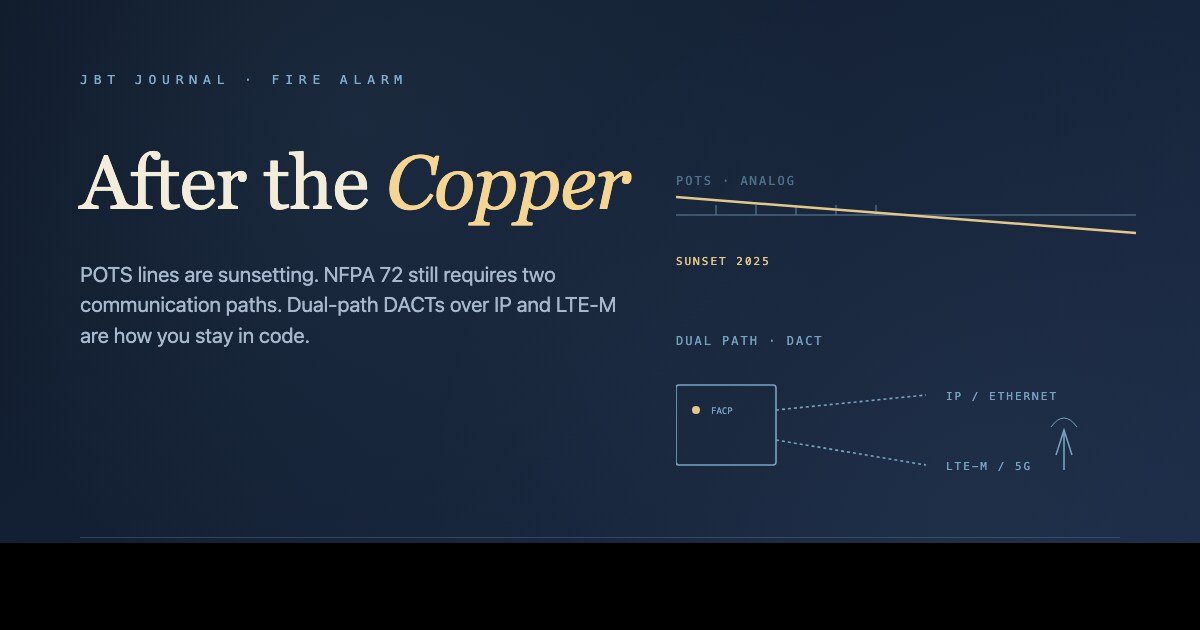
The most common 2026 specification. An IP-primary, cellular-failover communicator polls both paths independently. Loss of either path annunciates trouble at the panel. Total signaling reliability is high; supervision interval extends to 6 hours per path. This is what most AHJs prefer to see on new construction and major retrofits because the failure modes don't overlap.
Cellular-only communicators in basement mechanical rooms, MDF closets, or shielded structures (mass-timber with metallic vapor barriers, post-tensioned concrete) often have marginal RSSI. Test the actual installed signal level under load — not the bars on a phone in the hallway. If the cellular communicator can't maintain a session reliably from the actual install location, you don't have a working path; you have a paperwork path. AHJs in some jurisdictions are now asking for measured RSSI logs as part of acceptance.
Annual testing under the new rules
NFPA 72 Chapter 14 (Inspection, Testing, and Maintenance) requires the alarm signal to be received and acknowledged at the supervising station as part of the annual functional test — not just generated at the panel. Some AHJs are now explicitly asking for a printed central-station receipt log showing the test signal was received within the 90-second window. A panel that “rang at the panel” without a corresponding central-station receipt is an open finding.
For dual-path systems, the annual test includes an intentional failure of each path to verify trouble annunciation. The communicator's web interface or the central station's portal generally provides the path-status logs needed to document this without manually pulling cables.
Order of operations for a building still on POTS
If your building still has a DACT and a POTS pair (or a “POTS-equivalent” ATA at the demarc), here's the sequence that minimizes downtime and gets you to a code-compliant configuration before the next inspection:
- Document the existing path. Get a copy of the most recent annual test report, the central-station signal log for the past 90 days, and a photo of the demarc. If the carrier has already migrated you to managed IP, the demarc will show an ATA — that's the diagnostic clue.
- Verify the panel's communicator capability. Most fire alarm panels manufactured after 2010 (Notifier, Silent Knight, Edwards EST, Fire-Lite, Honeywell, Mircom, Simplex) accept IP/cellular communicators as a slot-in module. Older panels may need a head-end replacement or a stand-alone communicator wired to the dialer terminals.
- Confirm central-station compatibility. The receiving central station has to support the protocol the new communicator speaks (Contact ID over IP, SIA DC-09, AES IntelliNet, etc.). This is usually fine, but a 30-second call to the central station before ordering equipment prevents a return trip.
- Schedule the cutover with the AHJ in the loop. NFPA 72 requires notification to the AHJ for changes to the supervising-station configuration. A 24-hour notice via email is usually sufficient. During the cutover window, the central station is on a manual watch.
- Test end-to-end with central-station receipt verification. Place test alarms from the panel, confirm receipt at the central station within 90 seconds, intentionally fail each path, confirm trouble annunciates at the panel within 5 minutes. Get printed logs for the inspection file.
Bottom line
The POTS sunset is not a future problem — for most buildings it has already happened, and the failure mode is silent. The fire alarm panel still tests fine; the central station may not be receiving the signal. NFPA 72's 2022 supervision requirements are unambiguous about what counts as a working path, and AHJs are increasingly testing for end-to-end receipt rather than panel-side signal generation. The right time to remediate is before the deficiency is written, not after.
If your building is more than five years past its last fire alarm communicator upgrade and you can't produce a 90-day central-station receipt log, you are most likely already non-compliant with NFPA 72 and just don't have a finding yet. The remediation is generally a one-day cutover with a $1,500–$3,500 communicator and a service ticket. The alternative is sitting in front of the AHJ explaining why your annual test reports were accurate but the signaling wasn't.
Need to verify your fire alarm signaling path is actually compliant?
We'll review the panel, the demarc, the central-station receipt logs, and the most recent annual test — and tell you what you're working with before the AHJ does. No charge for the conversation.