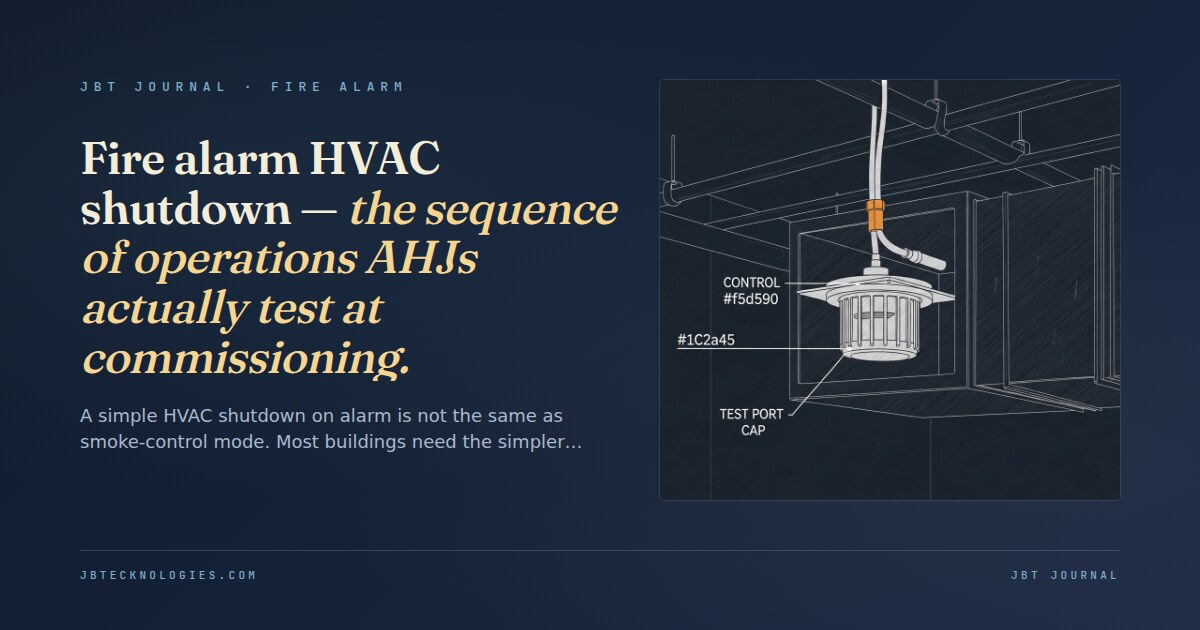
Fire alarm and HVAC integration gets specified as “shutdown on alarm” in most low-rise commercial projects and left at that. In practice, there are two substantially different systems that phrase can describe: a simple equipment-off interlock that kills HVAC fans on any alarm signal, and an engineered smoke-control mode that actively manages airflow to resist smoke migration between zones, floors, and stairwells. The commissioning test for each is different, the sequence of operations document for each is different, and the AHJ that witnesses commissioning will test whichever one the building permit drawings said the building has.
For most commercial buildings under 55 feet in height, the simpler version — HVAC shutdown on alarm — is what the code requires. Getting the sequence of operations document and the panel programming to match what the AHJ approved is where projects stall at commissioning. This post covers the interlock logic, the damper coordination, and the commissioning verification method for both systems.
Simple HVAC shutdown vs smoke-control mode — the governing codes
Simple HVAC shutdown on fire alarm is governed by NFPA 90A (Standard for the Installation of Air-Conditioning and Ventilating Systems) and referenced in IBC Section 606. The requirement: when a duct smoke detector activates, the air-handling unit serving that duct must shut down. When the fire alarm control panel goes into general alarm, all HVAC units must shut down or transition to a smoke-control mode. The AHJ’s specific requirement — shutdown only, or shutdown with damper closure, or recirculation to a holding mode — varies by jurisdiction and occupancy.
Smoke-control mode is an engineered smoke management system governed by IBC Chapter 909 and NFPA 92 (Standard for Smoke Control Systems). It is required for high-rise buildings, atriums over 55 feet, covered malls, and certain Group A and Group I occupancies. Smoke control doesn’t just shut HVAC down — it actively pressurizes stairwells and corridors, exhaust-ventilates the fire floor, and isolates the smoke zone from adjacent zones using a combination of fan operation and damper positions that vary based on which floor is in alarm. Our fire alarm services for Atlanta and Southeast commercial buildings include the sequence-of-operations development that ensures the panel programming matches the approved smoke-control design before the commissioning walk-through is scheduled.
Duct detectors — the overlooked trigger in most HVAC sequences
Duct smoke detectors are the primary device that links the fire alarm system to HVAC equipment in most commercial buildings. NFPA 90A requires a listed duct smoke detector in the supply air duct serving each air-handling unit with a capacity of 2,000 CFM or more. The duct detector activates when smoke enters the duct, and its alarm output shuts down the AHU it serves. It also signals the fire alarm control panel as an alarm or supervisory point — depending on how it is configured — and the panel programming determines whether the duct detector activation triggers building-wide shutdown or equipment-level shutdown only.
NFPA 72 allows duct smoke detectors to be configured as either alarm initiating devices or supervisory initiating devices. The configuration determines whether a duct detector activation triggers a general alarm (and all the notification and dispatch obligations that go with it) or a supervisory signal that only alerts building staff. The AHJ’s preference for which configuration to use varies by jurisdiction. Using alarm configuration when the AHJ expected supervisory — or vice versa — generates a plan review rejection or a commissioning deficiency that requires panel reprogramming before CO.
Damper coordination — the integration point that generates change orders
Smoke dampers and combination fire/smoke dampers in HVAC ductwork must close on signal from the fire alarm control panel. The coordination between the fire alarm contractor and the mechanical contractor is where the sequencing failures most often originate: the mechanical contractor installs the dampers with actuators sized for a specific control signal type (24 VDC, 120 VAC, or dry contact), and the fire alarm contractor connects the panel relay output to those actuators. If the control signal type doesn’t match, the actuator doesn’t operate on alarm — a failure that surfaces at commissioning, not at rough inspection, because the test requires a live alarm signal to the actuator.
| Damper type | Activation requirement | Code reference | Common coordination miss |
|---|---|---|---|
| Fire damper (FD) | Fusible link — no electrical activation | NFPA 80 | Assumed to be FA-controlled; it isn’t |
| Smoke damper (SD) | FACP relay or direct FA signal | NFPA 90A, IBC 909 | Wrong control voltage; actuator doesn’t respond |
| Combination F/SD | Fusible link + FACP signal | NFPA 80 + NFPA 90A | Electrical connection omitted; fails smoke-control test |
| Leakage-rated damper (LRD) | FACP signal; airtight closure verified | NFPA 92, IBC 909 | Leakage rate not verified; fails smoke-control commissioning |
The sequence of operations document — what AHJs look for
The sequence of operations (SOO) is a written narrative and/or matrix that describes exactly what happens in the fire alarm system and HVAC system for every alarm scenario: duct detector activation, pull station, heat detector, waterflow switch, general alarm. For each initiating event, the SOO documents which HVAC units shut down, which dampers close, which notification appliance circuits activate, and in what order. For smoke-control buildings, the SOO also documents which fans go to pressurization mode, which go to exhaust mode, and how the system transitions between zones as the fire zone changes.
The AHJ reviews the SOO as part of the permit submittal, and the commissioning test is conducted against the approved SOO. If the installed panel programming produces a different sequence than the SOO describes — dampers closing in the wrong order, units shutting down that the SOO says should stay on, notification zones activating outside their documented sequence — the test fails and the panel must be reprogrammed before a retest is scheduled. Addressable fire alarm panels make SOO verification faster at commissioning because the panel software can export a cause-and-effect matrix that maps directly to the SOO document. Conventional panels require manual testing of each initiating device and verification of each output without the software matrix support.
What commissioning agents verify at the FA-HVAC interlock test
For a simple HVAC shutdown building, the commissioning agent conducts a function test: each duct detector is tested with smoke or aerosol, and the agent verifies that the served AHU de-energizes and any required dampers close. Pull stations and waterflow devices are activated to verify general alarm triggers shutdown across all units. The test is documented against the approved SOO with pass/fail for each tested initiating event and output.
For a smoke-control building, NFPA 92 requires a formal acceptance test performed by a registered design professional or smoke-control engineer. The test verifies pressure differentials across smoke barriers, airflow rates in pressurized stairwells and corridors, and damper leakage rates — in addition to the functional interlock sequence. This test is substantially more time-consuming than a standard fire alarm commissioning walk and requires HVAC systems to be operational and balanced before the test. Scheduling the smoke-control acceptance test after HVAC commissioning but before fire alarm commissioning creates the sequence conflict that delays CO on smoke-control buildings. Georgia’s fire alarm inspection frequency requirements apply to the post-CO annual inspection cycle; the FA-HVAC interlock is tested at both initial commissioning and subsequent annual inspections under the NFPA 72 testing schedule.
Getting the sequence right before commissioning is scheduled
The most reliable way to avoid a commissioning failure on the FA-HVAC interlock is to review the approved SOO against the panel programming and the mechanical contractor’s damper as-built documentation before the AHJ inspection date is booked. A desktop review that verifies control signal types, actuator specifications, and panel cause-and-effect matrix against the approved SOO takes a few hours. A commissioning re-test after a failure takes weeks in a busy jurisdiction. The smoke-detector spacing post addresses the parallel issue in fire alarm commissioning: the inspection failures that happen because the installed condition doesn’t match the approved drawing, discovered at inspection rather than at review. Both problems are solved by the same discipline: verifying the installed condition against the approval before the inspector arrives.
Installing or commissioning a fire alarm system with HVAC integration in Atlanta or the Southeast?
We design and install NFPA 72-compliant fire alarm systems for commercial buildings in Atlanta and the Southeast — including the sequence-of-operations development, damper coordination, and pre-commissioning panel review that ensures the FA-HVAC interlock passes the first time.