The passive-vs-active decision for an in-building DAS is one of the earliest design choices on a mid-rise project, and it’s frequently made before the RF survey data that would justify it. The result is either an over-engineered active system in a building where passive would have worked, or a passive system that can’t deliver the downlink power the carriers require at the antenna tip after accounting for cable loss across twelve floors. Getting it right requires understanding what each architecture actually does with the signal, and where the crossover point is for a typical mid-rise.
Both ERCES (the public-safety in-building radio system mandated by IFC 510 and NFPA 1225) and commercial cellular DAS operate on distributed antenna systems — but they face different signal-level requirements and are governed by different design standards. The ERCES vs DAS post covers the distinction between the two systems and what can be shared between them. This post focuses on the passive-vs-active architecture decision for commercial DAS specifically, which is where the engineering tradeoffs are sharpest for mid-rise buildings in the 6–20 floor range.
What passive DAS actually is
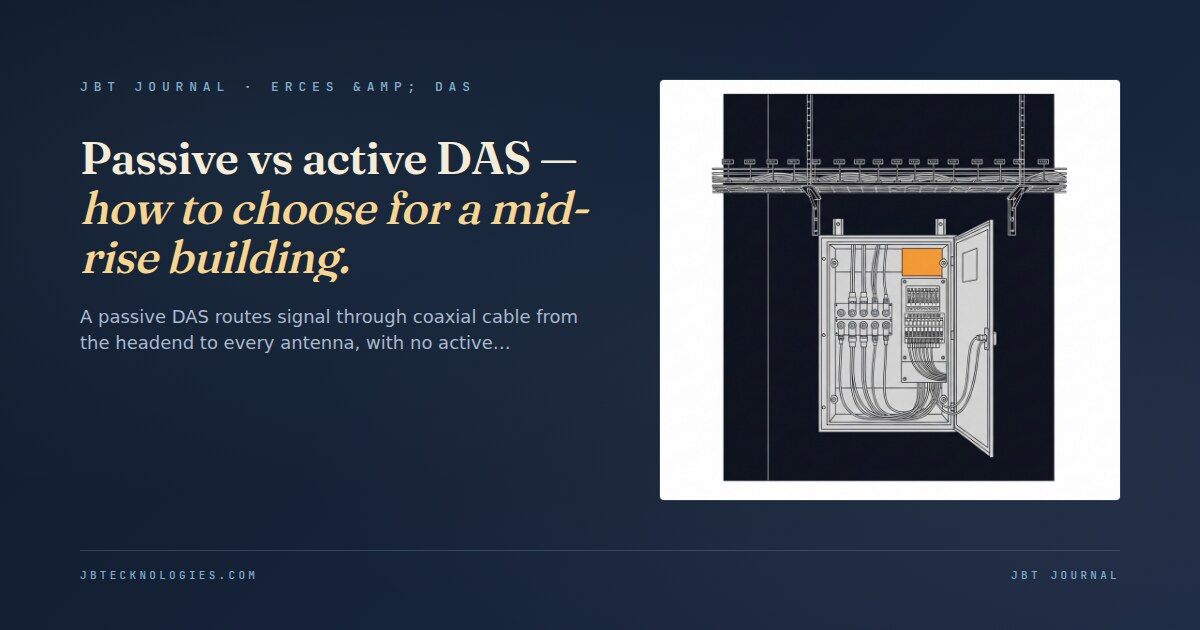
A passive DAS is a coaxial cable distribution network. Signal originates at a headend — typically a bi-directional amplifier (BDA) or a base station donor unit — and travels through a tree of splitters, couplers, and coaxial cable to each distributed antenna. There are no active components between the headend and the antennas: no remote units, no fiber-to-coax conversion, no per-antenna amplification. Power budget is a pure cable-and-splitting-loss calculation.
The fundamental constraint on passive DAS is that signal power falls with every dB of insertion loss in the cable plant. Coaxial cable has a frequency-dependent loss per unit length — on RG-6 at 2.5 GHz, roughly 7–9 dB per 100 feet. A 20-story building with 10-foot floor-to-floor heights and vertical risers plus horizontal distribution runs can accumulate 150–200 feet of cable to the farthest antenna on the top floor. That’s 11–18 dB of cable loss before you add splitter and coupler losses. On a 2.5 GHz band, a four-way splitter adds 6–7 dB of insertion loss. A headend that starts at +30 dBm can arrive at a distant antenna at +5–8 dBm — which may meet ERCES thresholds but fall short of carrier downlink requirements for LTE or 5G.
What active DAS actually is
An active DAS introduces active electronics between the headend and the antennas. The signal is typically converted to optical fiber at the headend (or at a master unit), distributed over single-mode or multimode fiber to remote units (RUs) on each floor or coverage zone, and re-amplified at each RU before connecting to local antennas via a short coaxial run. The RU is powered over a separate electrical circuit and typically requires a dedicated electrical connection at each location.
The active DAS architecture breaks the signal-loss-vs-distance constraint. Each RU regenerates the signal to a consistent output level regardless of how far the fiber run is from the headend. A 20-story building with an active DAS can have the same signal level at the top-floor antenna as at the second-floor antenna — limited by the RU output specification, not the cable run length. This is why active DAS is the standard architecture for high-rise and large-campus deployments where passive cable loss would require impractically high headend output power to compensate.
The RF link budget — where the math decides
The passive-vs-active decision for a mid-rise building comes down to whether the passive RF link budget closes at the antenna tip for the required signal levels. The budget has four main variables: headend output power, cable and splitter insertion loss, required antenna tip power, and the number of coverage zones the design must serve.
| Building size | Floors | Typical cable loss to farthest antenna | Architecture that closes |
|---|---|---|---|
| Small commercial | 1–4 | 8–15 dB | Passive; typically comfortable margin |
| Mid-rise | 5–12 | 15–30 dB | Passive may close at ERCES thresholds; active often needed for carrier |
| Mid-rise, large floor plate | 5–12, >50,000 sq ft/floor | 25–40 dB | Active almost always required |
| High-rise | 13+ | 40 dB+ | Active required |
The “mid-rise, passive may close” zone — roughly 5–12 floors with modest floor plates — is where the design choice genuinely exists and where the cost tradeoff is worth analyzing. A passive system for a 10-story building with 15,000 sq ft floor plates costs roughly $80,000–$150,000 installed. An active DAS for the same building with a single-carrier headend runs $200,000–$400,000. The gap is real, and it justifies a proper RF budget calculation before defaulting to active.
Maintenance and operational tradeoffs
Passive DAS has no powered components in the cable plant. A passive splitter that fails is a passive component replaced with a coaxial wrench and a splice kit. An active DAS has powered RUs on every floor that can fail, overheat, require firmware updates, and draw maintenance windows for software upgrades. In a building where IT maintenance resources are limited, a passive system that works reliably without firmware management is a real operational advantage.
The active DAS advantage in maintenance is fault isolation: when a single RU fails, the affected antennas are on that floor only. A passive cable failure that affects a trunk run above a splitter takes out everything downstream of that splitter — potentially multiple floors. Active DAS management systems also provide per-RU monitoring that passive systems can’t match: you know exactly which RU has failed and which floor is affected before the first technician rolls.
When passive is still the right answer for a mid-rise
Passive DAS is the right answer for a mid-rise when the RF budget closes, carrier participation isn’t required or the system is ERCES-only, and the building owner has a preference for lower long-term maintenance complexity. ERCES systems serving public-safety frequencies in mid-rise buildings of 5–10 stories on the 700/800 MHz band often close well on passive, because lower frequencies have significantly lower cable loss per hundred feet than the upper 2 GHz cellular bands. A passive ERCES system that serves first-responder coverage requirements might cost $60,000–$120,000 for a 10-story building where an active system with carrier participation would cost three times that. Our DAS for high-rise buildings page covers the same signal-penetration challenge from the commercial carrier side, where active architecture becomes the default above 15 floors for largely the same cable-loss physics that apply to the public-safety bands discussed here.
The honest evaluation of passive vs active for a mid-rise starts with an RF survey that measures the actual outdoor signal from the public-safety donor site (for ERCES) and the carrier donor sites (for commercial DAS), followed by a link-budget calculation that models the cable plant at the correct frequencies. The donor antenna siting post covers the outdoor signal survey methodology that feeds the link budget — a step that happens before the passive-vs-active decision, not after it. Skipping the survey and defaulting to active adds cost that may never be recovered. Skipping the survey and defaulting to passive risks a commissioning failure when the cable loss budget doesn’t close at carrier acceptance requirements.
Designing a DAS or ERCES system for a mid-rise building?
We design, permit, and commission DAS and ERCES systems for commercial buildings nationwide — including the RF survey and link-budget analysis that determines whether passive or active architecture is the right fit before the design is committed.