Low-light camera performance is one of the most marketing-intensive areas of the CCTV specification process. Every manufacturer claims best-in-class low-light sensitivity. Most specifications say “provide cameras suitable for low-light conditions” without defining what low light means or what performance standard the camera must meet. In a parking deck, that vagueness turns into a camera that either produces a useful image at 2 a.m. or produces a useless gray blur, and the difference between those outcomes is not brand loyalty — it’s sensor type, illuminator choice, and lens selection matched to the specific light level in each zone of the deck.
Starlight sensor technology — what it actually does
Starlight is a marketing term (used first by Hikvision, now industry-wide) for a camera sensor that is optimized for high sensitivity in very low ambient light without IR illumination. The sensitivity is achieved through a larger pixel size on the image sensor — typically 2.8 µm to 4 µm per pixel versus 1.4 µm to 2 µm on standard resolution sensors — combined with a faster lens aperture and an ISP (image signal processor) tuned for low-noise amplification at high ISO equivalents. The larger pixel captures more photons per exposure, which translates to a brighter, less-noisy image at the same scene illuminance.
In practice, a quality starlight camera can produce a clean color image at illuminance levels around 0.005 lux — roughly equivalent to a sky lit only by stars with no moon. A standard camera at that illuminance produces a nearly black image or a heavily compressed, noisy grayscale. The color retention at low light is the significant operational difference: a starlight camera recording a parking deck at night produces footage where a red car is clearly red and a blue jacket is clearly blue. An IR camera recording the same scene produces black-and-white footage where identifying clothing or vehicle color requires the operator to find another camera angle with better ambient light.
IR illuminator technology — how it actually works
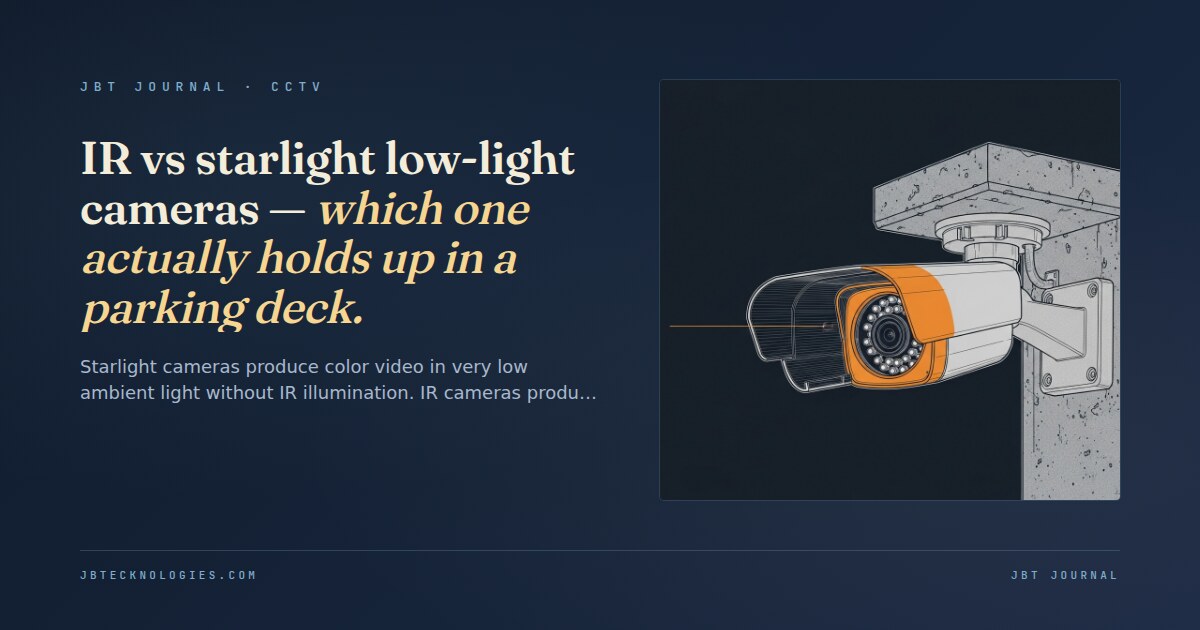
An IR-illuminated camera uses onboard near-infrared LEDs (typically 850 nm or 940 nm wavelength) to flood the scene with light that is invisible to the human eye but detectable by the camera sensor. The camera’s IR cut filter — which blocks IR light during daytime to produce accurate color — switches out of the optical path at night, converting the camera to IR-sensitive monochrome mode. The onboard IR LEDs illuminate the scene and the sensor captures the reflected IR light, producing a black-and-white image that can be very sharp and detailed even in complete ambient darkness.
IR illuminators have a rated effective range — typically 30 to 100 meters for commercial cameras — and an illumination angle that should be matched to the camera’s field of view. A camera with a 120-degree wide-angle lens paired with a 30-degree IR illuminator leaves the corners of the frame dark even though the center is well-lit. Many IR cameras have an “adaptive IR” or “smart IR” feature that reduces LED intensity when close subjects saturate the sensor, preventing the “white-out” effect when a person or vehicle moves close to the camera. Without adaptive IR, a person walking directly under a camera appears as a white blob with no detail.
Parking deck conditions — where each technology wins
A parking deck is not a uniform lighting environment. Most commercial parking decks have at least some ambient light — fluorescent or LED overhead fixtures at 50–200 lux in most covered areas, dropping to 5–20 lux in ramp transitions and uncovered areas at night, and near zero in equipment rooms and stairwell landings. The camera technology that performs best depends on which zone of the deck it’s covering.
| Deck zone | Typical illuminance | Starlight performance | IR performance | Recommended |
|---|---|---|---|---|
| Covered interior (lit) | 50–200 lux | Excellent; color retained | Good; may IR-cut to color mode | Starlight for color forensic value |
| Covered interior (dim) | 5–20 lux | Good; color noisy at 5 lux end | Good with onboard IR | Starlight or IR; specify adaptive IR |
| Ramp transitions, open areas | 0.1–5 lux at night | Marginal below 0.5 lux | Strong; IR range must cover zone width | IR; match illuminator angle to FOV |
| Stairwells, no overhead lighting | < 0.1 lux | Not usable | Very strong with adequate IR range | IR required; 940 nm for exterior |
The color forensic argument — when it matters and when it doesn’t
The primary operational advantage of starlight over IR in a parking deck is color retention: a starlight camera can tell investigators what color car was on level 3 at 11 p.m. An IR camera can tell them a car was on level 3 at 11 p.m. For facilities where vehicle color is a significant investigative variable — auto dealerships, hospital parking, high-theft environments — the forensic value of color night video is real and worth the additional sensor cost. For most commercial parking applications where the primary concern is presence detection and general situational awareness, the color advantage doesn’t justify a meaningful cost premium.
The forensic value calculus also interacts with resolution. A 4MP starlight camera at night may produce color video with visible noise at the lowest light levels. A 4K IR camera at the same light level produces sharp black-and-white video with better plate and face detail than the starlight sensor at a similar price point. Resolution and low-light performance trade off differently on starlight vs IR sensors because the larger pixels in starlight sensors that improve sensitivity also reduce the maximum pixel count for a given sensor die size. The camera selection decision for a parking deck should specify minimum illuminance performance, minimum resolution, and whether color retention is an investigative requirement — not just “low-light capable.” Our CCTV design services for Atlanta and Southeast commercial buildings include the illuminance measurement and camera selection process that matches sensor technology to each zone of the deployment, rather than specifying a single camera type for all conditions. The camera resolution vs storage post covers how resolution choices interact with storage budgets — a relevant consideration when moving from a lower-resolution standard camera to a 4MP or 4K starlight sensor in a deck with many cameras.
Specifying CCTV for a parking deck or low-light environment in Atlanta or the Southeast?
We design and install commercial video surveillance systems for Atlanta and Southeast facilities — including the illuminance measurements and camera-selection methodology that ensures low-light performance is matched to each coverage zone, not just labeled “low-light capable” in the specification.