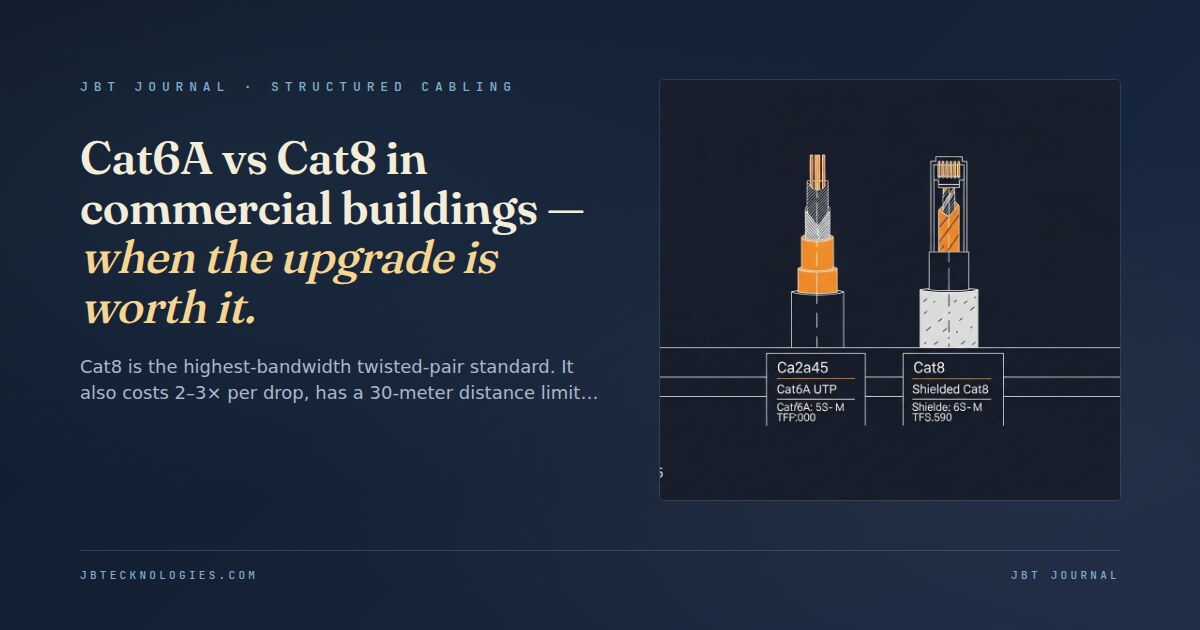
Cat8 entered the TIA-568 standard in 2016 and the conversations about whether to spec it over Cat6A have followed every commercial cabling project since. The answer for most commercial office buildings is Cat6A — the distance limitations and shielding requirements of Cat8 make it the wrong choice for general-purpose horizontal cabling in most office, healthcare, and light-commercial environments. But Cat8 is the correct choice for specific applications, and understanding where those are prevents both over-engineering and under-engineering the cable plant.
The fundamentals of structured cabling — pathway planning, TIA-568 requirements, backbone topology, and the decisions that govern the cable plant for 15+ years — are covered in the structured cabling 101 post. This post focuses on the Cat6A vs Cat8 decision specifically.
What Cat8 actually is — and what it isn’t
Cat8 (TIA-568.2-D Category 8) is a shielded twisted-pair cable specified for 2,000 MHz bandwidth, supporting 40GbE (40GBASE-T) at up to 30 meters and 25GbE (25GBASE-T) at up to 30 meters. There is no Cat8 standard for 100-meter runs at 40GbE — that channel length does not exist in the standard. Cat8 cables must use shielded construction (F/UTP or S/FTP); unshielded Cat8 does not exist as a standard designation.
Cat6A supports 10GbE (10GBASE-T) at 100 meters and 2.5GbE/5GbE at 100 meters, with a 500 MHz frequency limit. The performance gap between Cat6A and Cat8 is real and significant; the question is whether that gap matters for the application at hand.
Distance: the Cat8 constraint that rewrites the architecture
The 30-meter channel-length limit for Cat8 at 40GbE is the most consequential difference between Cat8 and Cat6A for commercial building cabling. A standard TIA-568 horizontal cabling channel allows up to 100 meters from the IDF to the work area outlet. In commercial buildings, IDF closets are positioned to serve a floor radius, and work area drops are frequently 30–80 meters from the TR. Cat8 at 40GbE cannot serve those runs; Cat6A at 10GbE can.
The implication: Cat8 is usable for horizontal cabling only in buildings where the IDF-to-workstation distance is consistently below 30 meters. In practice, this means buildings specifically designed around short-run cabling infrastructure — data centers with high-density server rooms, trading floors with centralized switch infrastructure, or purpose-built lab environments with adjacent TRs. In a standard commercial office building with a perimeter telecommunications room, Cat8 cannot serve the far drops at the distances they actually run.
The shielding requirement and what it costs in practice
Cat8 is a shielded cable category. This means the entire infrastructure must be shielded: shielded patch panels, shielded keystones or termination blocks, grounded racks, and properly bonded infrastructure throughout. In a building with existing unshielded (UTP) pathway infrastructure and unshielded patch panels, implementing Cat8 requires replacing the termination infrastructure throughout — a cost entirely separate from the cable cost per drop.
Shielded infrastructure also requires correct grounding. An improperly grounded shielded cabling system is worse than an unshielded one: the shield becomes an antenna for conducted noise rather than a barrier against it. In retrofit commercial buildings where grounding practices are inconsistent, this is a real engineering constraint that adds time and cost to the shielded implementation. The permit requirements for that installation are the same regardless of cable category; the low-voltage permit requirements by jurisdiction post covers the Georgia-specific picture.
Where Cat8 makes sense — and where Cat6A is the right answer
| Application | Recommended standard | Reason |
|---|---|---|
| Commercial office, standard floor plate (30–80m runs) | Cat6A | Cat8 cannot serve runs over 30m at 40GbE; Cat6A handles 10GbE at full channel length |
| Data center top-of-rack patching (< 15m) | Cat8 or fiber (DAC/AOC) | Short, predictable runs; 25/40GbE requirements; dense rack environment |
| Healthcare, standard patient rooms and offices | Cat6A | Distance and network demand match Cat6A; hospital construction cost premium not warranted for general areas |
| Trading floor / fintech (short-run, high-density, < 30m) | Cat8 | Latency-sensitive 25/40GbE applications; controlled environment designed for shielding |
| Warehouse / industrial (variable run lengths) | Cat6A or fiber | Variable distances likely exceed Cat8 limit; fiber provides distance flexibility |
Cat8 cabling typically runs 2–3× the materials cost of Cat6A per drop. In a 200-drop commercial office installation, the Cat8 premium can add $30,000–$60,000 in materials above a Cat6A spec, before accounting for shielded patch panels, keystone hardware, and grounding infrastructure. That cost premium buys 40GbE capability that most commercial workstations cannot use and a distance limit that most commercial office runs already exceed.
The future-proofing argument — and whether it holds
The most common argument for Cat8 in commercial buildings is future-proofing: “we’ll need 40GbE to the desktop eventually.” This argument has two problems. First, the 30-meter distance limit means Cat8 horizontal cabling physically cannot serve typical commercial office runs regardless of future bandwidth demand — you would need to relocate telecommunications rooms to bring them within 30 meters of workstations, which is an architectural change, not a cabling change. Second, 40GbE to the desktop is a data center requirement; commercial office workstations running at 10GbE are well-served for the foreseeable future.
The more defensible future-proofing argument is for MTP/MPO fiber backbone infrastructure for building risers, which supports 40GbE, 100GbE, and beyond without the distance constraints of copper. The MTP/MPO trunk vs field-terminated fiber post covers the backbone design decisions; in most new commercial construction, a Cat6A horizontal plant paired with an OS2 or OM4 fiber backbone is the architecture that ages well without over-specifying the horizontal copper.
For commercial buildings in Atlanta and the Southeast planning a structured cabling installation, the right specification almost always lands at Cat6A for horizontal cabling and fiber for backbone. Our structured cabling services include the site survey and pathway design that establish what each building can actually support before the cable spec is locked in.
Planning a structured cabling installation in Atlanta or the Southeast?
We survey, design, and install Cat6A and fiber backbone systems for commercial buildings — with the pathway design and specification that ensures the cable plant works at commissioning and for the next 15 years. Serving Atlanta and the Southeast.