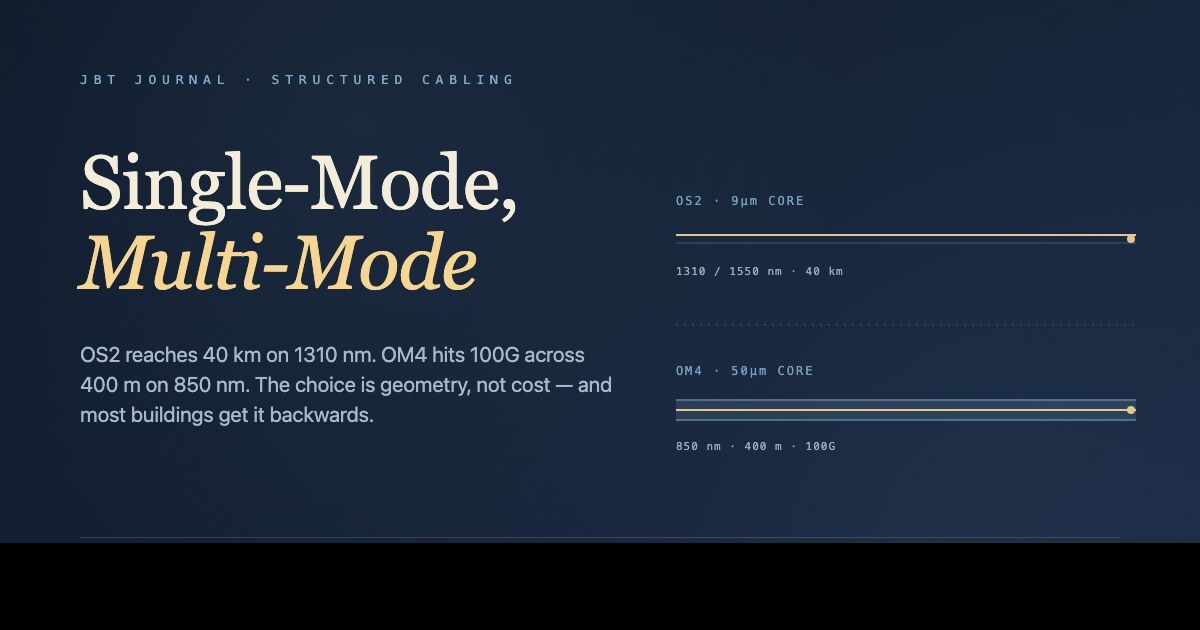
The structured cabling spec lands on the engineer's desk: OM4 multimode, 12-strand riser, between MDF and each IDF, 50/125. Six months later, the network team needs to upgrade campus links from 10G to 100G, and the cheapest 100G optics on the upgrade list need single-mode fiber, not OM4. The fiber that was already pulled becomes a cost line in someone else's project.
The OS2-vs-OM4 conversation in low-voltage circles usually starts as a fiber-type debate. It's the wrong debate. The fiber type is a function of three things: the reach you need, the bandwidth you'll grow into, and the transceiver economics over the life of the building. Get those three right and the fiber type follows automatically.
What's actually different between OS2 and OM4
OS2 is single-mode fiber: a 9 micrometer core, designed for laser sources, capable of any bandwidth a transceiver vendor wants to put on it for any reach a customer wants to support — up to ~80 km without amplification, longer with EDFAs and dispersion compensation.
OM4 is laser-optimized multimode fiber: a 50 micrometer core with a precisely engineered refractive-index profile, designed for VCSEL sources, capable of 10 Gigabit at 400 m, 40 Gigabit at 150 m (40GBASE-SR4), 100 Gigabit at 150 m (100GBASE-SR4), and limited reach beyond that.
OM5 is wideband multimode — OM4 with a refractive-index profile tuned for short-wavelength division multiplexing (SWDM4). It supports 100 Gigabit on a single pair (instead of OM4's four-pair parallel transmission). Notable, but as we'll see, it's the answer to a question most buildings don't have.
The transceiver cost reality
Cable cost differences are small at building backbone lengths. OS2 12-strand riser is roughly 10–15% cheaper than OM4 12-strand. The cost driver is on the optics, where the historical math has been:
- 10G short-reach SR / SR-S (OM4): $40–$80 each.
- 10G long-reach LR / LRL (OS2): $80–$200 each.
- 40G SR4 (OM4, 8 fibers): $300–$600 each.
- 40G LR4 (OS2, 2 fibers): $1,200–$2,500 each.
- 100G SR4 (OM4, 8 fibers): $400–$900 each.
- 100G LR4 (OS2, 2 fibers): $1,500–$3,500 each.
That math is where the OM4 argument has historically lived: the optics are cheaper. But the comparison hides three points that change the answer.
One: 100G SR4 needs 8 fibers per link. 100G LR4 needs 2 fibers per link. The fiber-strand economics flip the comparison. A 24-strand OS2 riser supports 12 simultaneous 100G LR4 links. A 24-strand OM4 riser supports 3 simultaneous 100G SR4 links. The cost-per-link math has to include the cable plant capacity, not just the optics.
Two: single-mode optics have collapsed in price. BiDi single-mode optics from the white-box vendors (FS, Approved Networks, Wavesplitter, generic-OEM) are now $300–$600 for 100G LR4 in many cases. The Cisco/Arista/Juniper-branded versions stay expensive; the third-party-coded equivalents do not. For most enterprises, the 3–5x premium that single-mode used to carry is closer to 1.5x today.
Three: the next jump is 400G and 800G. 400GBASE-SR8 needs 16 fibers per link on OM4; 400GBASE-DR4 needs 8 on OS2; 400GBASE-FR4 / LR4 needs 2 on OS2. The fiber-strand cost gap widens at every speed bump.
Reach math at common speeds
Maximum link distances, current standards:
| Speed / standard | OM4 reach | OS2 reach |
|---|---|---|
| 10G (SR / LR) | 400 m | 10 km |
| 25G (SR / LR) | 100 m | 10 km |
| 40G SR4 / LR4 | 150 m | 10 km |
| 100G SR4 / LR4 | 100 m | 10 km |
| 400G DR4 / FR4 / LR4 | 100 m (SR8) | 500 m / 2 km / 10 km |
The pattern is clear: as speeds climb, OM4's reach shrinks. A 100-meter limit at 100G is fine for a single-floor data hall. It is not fine for a 12-story office tower's MDF-to-IDF backbone, where the riser run can easily exceed 100 m by the time pathway distance and slack are accounted for.
Where OM4 still wins
- Data center fabric within a single hall. Top-of-rack to spine, end-of-row to leaf, distances under 100 m, where SR optics are cheapest and the strand count isn't a problem because the fiber is in trunks not risers.
- Single-floor enterprise where every IDF is within 100 m of the MDF. Some smaller buildings, retail, and education campuses fit this profile.
- Existing OM4 plants that don't need a 25G+ upgrade. If the building is finished, OM4 is already pulled, and the speed roadmap caps at 10G, there's no reason to disturb anything.
Where OM4 is a 10-year trap
- Multi-floor buildings > 4 stories. Riser reach + slack will exceed 100 m at some pairing of MDF to highest IDF.
- Campus links between buildings. Even 200–300 m runs are at the OM4 limit for current speeds and beyond it for next-generation.
- Healthcare, higher education, large industrial campuses. Long-lived buildings where the speed roadmap will eventually want 400G+ and the fiber pulled in 2026 has to support it.
- Buildings that will see a tenant turnover in less than 15 years. The fiber outlasts the tenant. The next tenant's speed needs are unknown today.
OM5 — the answer to the wrong question
OM5 was developed to extend multimode's relevance into 100G+ on a single pair via SWDM4. It does what it says, but the cost premium over OM4 is real, the supported optics are more limited, and the reach gains are modest compared to single-mode. For most buildings choosing in 2026, the OM5 case is weak: if the goal is 100G+ across longer distances, OS2 with white-box optics is the simpler answer.
Bottom line — the right question
For a backbone investment that has to last 15–25 years, the question isn't “which fiber type wins on today's optics?” It's “which fiber type covers any reach and any speed I might want to support, with optics that are or will be commoditized?” OS2 single-mode wins that question structurally. The fiber cost is barely different. The optics premium has collapsed. The reach is unlimited at building scale. The strand count needed for high-speed parallel transmission is a third of what multimode needs.
For most multi-floor commercial buildings, healthcare facilities, higher-education campuses, and industrial sites being designed in 2026, the right backbone spec is OS2 12- or 24-strand riser with hybrid OS2+OM4 trunk where short-reach data center fabric is also needed. Pull what you can't replace later. Spend on the cable plant. Save on the optics — but never the other way around.
Specifying a backbone for a building that has to last?
We do hybrid OS2/OM4 designs against actual reach + speed roadmaps, with itemized 15-year transceiver economics so the structured cabling spec is defensible against the next CFO who asks why.