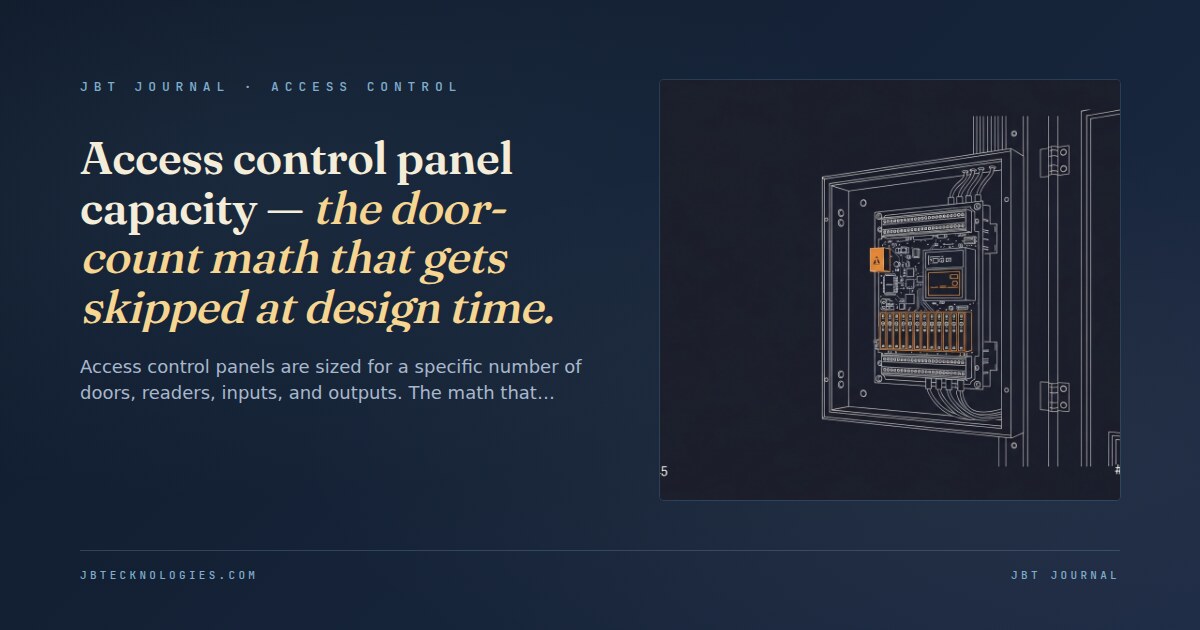
Access control systems get designed to the current door count, installed to that count, and then expanded as the building changes. The problem is that panel capacity limits are fixed at hardware specification time. When an expansion exceeds the panel’s door or I/O capacity, the choices are: buy another panel, rewire to redistribute the door count across panels, or compromise the expansion with a panel that’s underspecified for the reader configuration. None of those choices are cheaper or faster than leaving planned headroom at initial design.
The technology platform also matters: cloud-based access control systems and on-premises systems handle panel capacity and expansion differently. The platform decision and what it means for long-term expansion cost is covered in the cloud vs on-prem access control post. This post focuses on the physical panel hardware capacity constraints that apply regardless of which platform is chosen.
How access control panels are structured and sized
An access control system typically has two hardware tiers: the controller (sometimes called the main panel or intelligent controller) and subpanels (reader interface boards or door controllers). The main controller handles database processing, policy evaluation, and network communication; subpanels are the hardware at each door that reads credentials, controls the lock output, and monitors the door contact.
Panel capacity is expressed in several dimensions that all apply simultaneously:
- Door/reader count: The number of reader ports the panel supports. Most standard subpanels support 2 or 4 doors with one reader per door (entry only) or 2 readers per door (entry/exit). A 4-door subpanel with 2 readers per door consumes 8 reader ports.
- Input point count: The number of supervised input circuits for door contacts, REX buttons, motion detectors, and alarm inputs. Standard subpanels offer 8–16 inputs; each door typically requires 2–3 (door contact, REX, optional alarm).
- Output/relay count: The number of relay outputs for lock control, auxiliary outputs, and elevator control. Standard doors require 1–2 outputs each (strike/mag-lock, auxiliary). Elevator floor-by-floor control multiplies output count significantly.
- Subpanel count per controller: The main controller supports a defined maximum number of subpanels on its access control network (typically RS-485 or proprietary bus). Exceeding that limit requires a second controller or a network expansion module.
Reader-to-panel ratio math — a worked example
A 40-door commercial office building using 2 readers per door (badge in, badge out) requires 80 reader ports total. A common commercial-grade subpanel supports 4 doors (8 readers) per board. That’s 10 subpanels. If the main controller supports a maximum of 8 subpanels, the 40-door design already exceeds a single-controller capacity at 2 readers per door — before any expansion is considered. Specifying a controller rated for 16 subpanels at initial design avoids the mid-project discovery that the controller cannot support the door count as designed.
The expansion scenario is where the math becomes expensive. If the same 40-door building adds 10 doors in a tenant buildout two years later, and the original controller is at its 8-subpanel maximum, the expansion requires a second controller, a second network path, and licensing for the second controller in the access software — plus the wiring to connect the new controller back to the server. That cost is typically $3,000–$8,000 in hardware and labor before any door hardware is added. A controller with headroom for 12 subpanels at initial design would have absorbed the expansion with 2 additional subpanels at $400–$800 each.
The platform licensing dimension
Hardware panel capacity is one constraint; software licensing is another. Most commercial access control platforms (Lenel OnGuard, Genetec Security Center, Software House C-CURE, Brivo, Verkada) license by door count or reader count. Adding doors beyond the licensed count requires a licensing upgrade. On perpetual-license on-premises platforms, that license upgrade may be a one-time purchase or require a maintenance contract expansion. On subscription platforms, it may change the pricing tier. Neither is free, but the surprise comes when the organization assumes that “the panel has room for more doors” is the same as “we can add more doors without additional cost.”
The relationship between credential technology and platform licensing is the same dimension that affects mobile credential deployments: a switch from Wiegand readers to OSDP readers for mobile credential support may require not just reader replacement but a controller with OSDP capability, which in some platforms is a separate model from the standard Wiegand controller. The mobile credentials vs badge readers post covers the reader replacement scope and its cost implications.
How to plan for the right headroom at design time
A defensible access control panel capacity plan answers three questions at design time:
- What is the current door count by type? Entry/exit (2 readers), entry-only (1 reader), secure perimeter (1 reader + alarm), elevator (relay outputs only). Each type has a different I/O consumption profile.
- What are the probable expansion scenarios in the next 5–7 years? Known future tenant spaces, planned elevator control, future parking gate integration. A 20–30% capacity buffer applied to the confirmed door count accommodates most medium-term expansions without a controller upgrade.
- What is the cost delta between specified capacity and next-tier capacity? The incremental cost of specifying a 16-subpanel controller vs an 8-subpanel controller at initial installation is typically $800–$2,000 in hardware. That cost prevents a $3,000–$8,000 retrofit when the building grows to 9 subpanels.
| Door count range | Recommended controller spec | Headroom guidance |
|---|---|---|
| 1–16 doors | Minimum 32-door controller or 4-subpanel chassis | Specify 2× current count; most expansions in this range are proportionally large |
| 17–64 doors | Enterprise controller supporting 8–16 subpanels | 30% buffer minimum; confirm elevator and I/O expansion in I/O capacity |
| 65–256 doors | Multi-controller architecture from initial design | Plan redundancy and load distribution across controllers; license all controllers upfront if perpetual-license platform |
Access control systems designed to exact current door count tend to generate change orders within 24 months as tenant layouts change, security zones are added, or parking and elevator control is integrated. Our access control design process for Atlanta and Southeast commercial buildings includes the capacity planning math before hardware is specified, so the system delivered is the one the building can actually grow into.
Designing an access control system for Atlanta or the Southeast?
We specify, install, and commission access control systems for commercial buildings in Atlanta and the Southeast — including the panel capacity planning that ensures the system the building needs today can support the building it will be in 5 years.